| |
Vitamin C (IV) Research - Clinical Trials
________________________________________
|
Vitamin C (IV) Research - Videos
________________________________________
|
Vitamin C (IV) Research - Featured Articles
| Vit C |
 |
Introduction - Intravenous (IV) High Dose Vitamin C - Kills Cancer Cells |
 |
|
Recall how hydrogen peroxide is poured on wounds to kill germs. Well now researchers clearly show high-dose vitamin C, when administered intravenously, can increase hydrogen peroxide (H2O2) levels within cancer cells and kills them. I.V. vitamin C was also demonstrated to kill germs and may be an effective therapy for infectious disease.
With a growing body of evidence mounting, National Institutes of Health (NIH) researchers conceded today that intravenous vitamin C may be an effective treatment for cancer. Two years ago, the same researchers reported a similar study but the news and media failed to publish it.
The latest study, published in the Proceedings of the National Academy of Sciences, confirms the work of Nobel-Prize winner Dr. Linus Pauling who conducted cancer research in the 1970s with vitamin C. Dr. Pauling's studies were discredited at the time by poorly conducted research studies at the Mayo Clinic.
Unlike cancer drugs, I.V. vitamin C selectively killed cancer cells, but not healthy cells, and showed no toxicity. The ability of intravenous vitamin C to kill lymphoma cells was remarkable almost 100% at easily achievable blood serum concentrations.
For inexplicable reasons, NIH researchers continue to maintain high-dose oral vitamin C can produce a limited increase in serum vitamin C concentrations. However, their earlier study published in 2004 clearly showed oral-dose vitamin C can achieve three times greater blood concentration than previously thought possible, a fact which negates the current Recommended Dietary Allowance for vitamin C. [Annals Internal Medicine 140:5337, 2004] NIH researchers refuse to issue a retraction of their earlier flawed research which mistakenly claimed humans cannot benefit from high-dose oral vitamin C supplements.
The NIH also offered no explanation why it has taken 35 years to confirm the work of Dr. Linus Pauling.
As feared by many oncologists, small doses may actually help the cancer cells because small amounts of vitamin C may help the cancer cells arm themselves against the free-radical induced damage caused by chemotherapy and radiation. Only markedly higher doses of vitamin C will selectively build up as peroxide in the cancer cells to the point of acting in a manner similar to chemotherapy. These tumor-toxic dosages can ONLY be obtained by intravenous administration.
Intravenous vitamin C also does more than just kill cancer cells. It boosts immunity. It can stimulate collagen formation to help the body wall off the tumor. It inhibits hyaluronidase, an enzyme that tumors use to metastasize and invade other organs throughout the body. It induces apoptosis to help program cancer cells into dying early. It corrects the almost universal scurvy in cancer patients. Cancer patients are tired, listless, bruise easily, and have a poor appetite. They don't sleep well and have a low threshold for pain. This adds up to a very classic picture of scurvy that generally goes unrecognized by their conventional physicians.
To summarize, most organisms make their own vitamin C. When they are under stress, either by illness or injury, Mother Nature has provided them with a means to facilitate healing: they synthesize more ascorbic acid. As a result, they are in less pain, they remain active, they can sleep, and they have a better appetite: all functions which promote healing.
Dr. Riordan once said that here at The Center, we don't treat cancer... we treat people who happen to have cancer. IVC is a tool that allows our Center physicians to harness a healing mechanism that our human ancestors lost long ago: the ability to dramatically increase tissue levels of vitamin C. Research shows that the astonishingly high levels achievable only by IVC not only help fight the risk of infection and the pain of metastases, they actually aid in the defeat of the cancer cells themselves, through a very elegant mechanism that does no harm to healthy cells. It's a discovery that the medical world is only beginning to discover. |
| |
|
|
| |
|
|
| Vit C |
|
3 Case Studies - Canadian Medical Journal - Intravenous (IV) Vitamin C - Cancer Research |
|
|
At concentrations above 1000 μmol/L, vitamin C is toxic to some cancer cells but not to normal cells in vitro. We found 3 well-documented cases of advanced cancers, confirmed by histopathologic review, where patients had unexpectedly long survival times after receiving high-dose intravenous vitamin C therapy.
We examined clinical details of each case in accordance with National Cancer Institute (NCI) Best Case Series guidelines.
Tumour pathology was verified by pathologists at the NCI who were unaware of diagnosis or treatment. In light of recent clinical pharmacokinetic findings and in vitro evidence of anti-tumour mechanisms, these case reports indicate that the role of high-dose intravenous vitamin C therapy in cancer treatment should be reassessed. |
| |
|
|
| |
|
|
| Vit C |
|
Article - Leukemia - Case Study - New Zealand Hospital |
|
|
"Having been cured from Leukemia using natural products and high dose Vitamin C myself", says spokeswoman Nicola Grace, "I am excited that finally the truth is coming out about natural cures for infectious diseases and cancer.
Now that this simple, cheap and effective treatment is implicated in the spontaneous remission of what a team of specialists were convinced was a terminally fatal case of swine flu, as well as hairy cell leukaemia, it would be negligent to ignore and criminal to deny high dose intravenous Vitamin C for future swine flu and/or hairy cell leukaemia admissions" she states. |
| |
|
|
| |
|
|
| Vit C |
|
Cancer - 01 - Concentrations - Pharmacologic Ascorbic Acid (Vit C) Concentrations Selectively Kill Cancer Cells |
|
|
Action as a pro-drug to deliver H2O2 hydrogen peroxide to tissues. These data indicate that (Vit C) ascorbate at concentrations achieved only by i.v. administration may be a pro-drug for formation of H2O2, and that blood can be a delivery system of the pro-drug to tissues ... giving plausibility to i.v. ascorbic acid (Vit C) in cancer treatment, and positive implications for treatment of infections where H2O2 may be beneficial. |
| |
|
|
| |
|
|
| Vit C |
|
Cancer - 02 - Concentrations - A Concentration-Function Approach Yileds Pharmacology and Therapeutic Discoveries |
|
|
For pharmacologic ascorbate (Vit C) to promote cancer cell death, H2O2 must be formed. There are many downstream targets of H2O2 and they almost certainly involve the actions of reactive oxygen species. ROS can have direct effects on a wide variety of biologically important molecules, including lipids, DNA, RNA, and proteins. The summation of damage and repair elicited by H2O2 differs according to cell and tissue type, which is integral in an individual cancer cell’s sensitivity and ultimate ability to either survive or succumb to pharmacologic ascorbate. |
| |
|
|
| |
|
|
| Vit C |
|
Cancer - 02 - Concentrations - A Concentration-Function Approach Yileds Pharmacology and Therapeutic Discoveries |
|
|
For pharmacologic ascorbate (Vit C) to promote cancer cell death, H2O2 must be formed. There are many downstream targets of H2O2 and they almost certainly involve the actions of reactive oxygen species. ROS can have direct effects on a wide variety of biologically important molecules, including lipids, DNA, RNA, and proteins. The summation of damage and repair elicited by H2O2 differs according to cell and tissue type, which is integral in an individual cancer cell’s sensitivity and ultimate ability to either survive or succumb to pharmacologic ascorbate. |
| |
|
|
| |
|
|
| Vit C |
|
Cancer - 03 - High-Dose Vitamin C (Ascorbic Acid) Therapy in the Treatment of Patients with Advanced Cancer |
|
|
As research results concerning ascorbate acid (Vit C) pharmacokinetics and its mechanisms of action against tumor cells have been published, and as evidence from case studies has continued to mount that ascorbate therapy could be effective if the right protocols were used, interest among physicians and scientists has increased. |
| |
|
|
| |
|
|
| Vit C |
|
Cancer - 04 - Intraveous Vitamin C as a Chemotherapy Agent: a Report on Clinical Cases |
|
|
The cancers cases reviewed are the following: Renal cell carcinoma (2), Colorectal cancer (1), Pancreatic cancer (1), Non-Hodgkin's lymphoma (2) and breast cancer (1). Toxic reactions were not observed at these high doses of intravenous Vitamin C.
|
| |
|
|
| |
|
|
| Vit C |
|
Cancer - 05 - Intraveous Vitamin C - Re-evaluation of prolongation of survival times in terminal human cancer |
|
|
Survival times were measured not only from the date of “untreatability” but also from the precisely known date of first hospital attendance for the cancer that eventually reached the terminal stage.
The ascorbate-treated patients were found to have a mean survival time about 300 days greater than that of the controls.
Survival times greater than 1 yr after the date of untreatability were observed for 22% of the ascorbate-treated patients and for 0.4% of the controls.
The mean survival time of these 22 ascorbate-treated patients is 2.4 yr after reaching the apparently terminal stage; 8 of the ascorbate-treated patients are still alive, with a mean survival time after untreatability of 3.5 yr. |
| |
|
|
| |
|
|
| Vit C |
|
Cancer - Leukemia - Case Study - New Zealand Hospital |
|
|
"Having been cured from Leukemia using natural products and high dose Vitamin C myself", says spokeswoman Nicola Grace, "I am excited that finally the truth is coming out about natural cures for infectious diseases and cancer.
Now that this simple, cheap and effective treatment is implicated in the spontaneous remission of what a team of specialists were convinced was a terminally fatal case of swine flu, as well as hairy cell leukaemia, it would be negligent to ignore and criminal to deny high dose intravenous Vitamin C for future swine flu and/or hairy cell leukaemia admissions" she states. |
| |
|
|
| |
|
|
| Vit C |
|
Cancer - Neuroblastoma - 01 - Vit C Enhances the Effects of 6-Hydroxdopamine and H202 in Neuroblastoma Cell Line |
|
|
Results suggest that continuous application of a high dosage of ascorbic acid (Vit C) might be a useful approach in neuroblastoma therapy. |
| |
|
|
| |
|
|
| Vit C |
|
Cancer - Neuroblastoma - Mice - Effect of Ascorbic Acid (Vit C) & H2O2 Hydrogen Peroxide on Mouse Neuroblastoma Cells |
|
|
At pharmacological concentrations (1-6 mM), ascorbic acid (Vit C) caused dose-dependent cell death. The lethal concentration at which 50% cells were killed (LC50) was determined to be approximately 3.141 mM ascorbic acid (Vit C) at 24 h. Cell death was partly mediated through the loss of total glutathione levels in the cells. The combination of ascorbic acid (Vit C) and H2O2 is disadvantageous for cancer cell survival. |
| |
|
|
| |
|
|
| Vit C |
|
Connective Tissues - Vitamin C & MSM - Anti-Inflammatory - Rebuilding Connective Tissues |
|
|
What we really want vitamin C for is to rebuild our connective tissue, to get our tissue to be healthy, and that is the anti-inflammatory effect. Generally, you want to take your MSM and vitamin C together if you can. I always prefer the natural vitamin Cs that are on the market today, for example Acerola Cherry vitamin C, or rosehip vitamin C because it’s the real vitamin C.
According to Dr. James Duke and his research on vitamin C, the best of the vitamin C botanicals (which is a fancy word for these vitamin Cs that are made out of the whole plant) is camu berry. I put in my Superfoods book, the details that Dr. James Duke has put up on his website about camu berry and its anti-inflammatory power. He actually ranks it as number one anti-inflammatory, which is amazing. I love camu berry.
I think MSM works a little bit better though because you can dose a little higher on it. If you get to a high dosage of vitamin C you start to have a little bit of diarrhea and those kinds of side effects. So, start small, build up big. Maybe you want to work up to 3,000 mg per day of a vitamin C supplement, and preferably a vitamin C plant-based supplement or botanical. |
| |
|
|
| |
|
|
| Vit C |
|
Cosmetics - Final Report - of the Safety Assessment of L-Ascorbic Acid as used in cosmetics. |
|
|
The Panel believed that the clinical experience in which Ascorbic Acid was used on damaged skin with no adverse effects and the repeat-insult patch test (RIPT) using 5% Ascorbic Acid with negative results supports the finding that this group of ingredients does not present a risk of skin sensitization. These data coupled with an absence of reports in the clinical literature of Ascorbic Acid sensitization strongly support the safety of these ingredients. |
| |
|
|
| |
|
|
________________________________________
|
| Vit C |
|
Heart - Use of Ascorbic Acid (Vitamin C) in Open Heart Surgery as an Oxygen Free Radical Scavenger |
|
|
Results of biochemical analysis supported the effect of ascorbic acid (vitamin C) as an oxygen difference between two groups. This is thought to be related to the factors which were non-uniformly distributed in both groups (pulmonary hypertension, positive inotropic, preload, afterload reducing medications) directly effecting the hemodynamic condition.
|
| |
|
|
| |
|
|
________________________________________
|
| Vit C |
|
2011 - FDA - Banning Injectable Vitamin C: What’s Next from the FDA? |
|
|
The FDA has just notified small pharmacies that they will no longer be allowed to manufacture or distribute injectable vitamin C—despite its remarkable power to heal conditions that conventional medicine can’t touch. Please help reverse this outrageous decision!
What possible rationale is offered? Because it’s dangerous? No. Because it can’t be patented and therefore won’t be taken through the standard FDA approval process.
The government, instead of banning intravenous vitamin C, should instead be supporting research into it. Even though IV C is being used in burn units around the world, including in the US, and has been adopted by the military for this purpose, the National Institutes of Health (NIH) refuses to fund any studies using intravenous C in patients. There are privately funded studies currently underway, but of course these cannot continue if the FDA bans the substance. |
| |
|
|
| |
|
|
________________________________________
|
| Vit C |
|
Vitamin C Bring New Zealand Farmer - Allan Smith - Back from Certain Death ... Swine Flu - Coma - Anaemia - Leukemia !!! |
|
|
We can thank "60 Minutes" New Zealand for this...
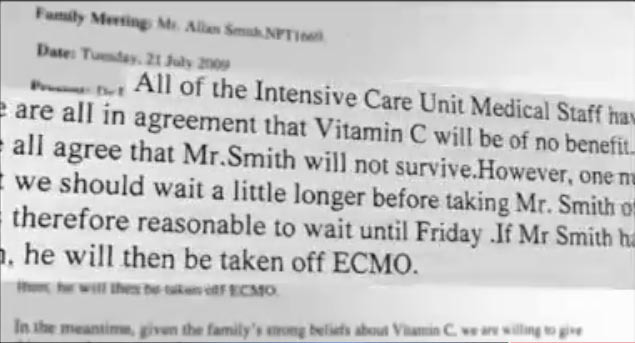
They recently produced and broadcast the story of Allan Smith, a dairy farmer in New Zealand who contracted Swine flu in 2009 and, lungs filling up with mucous, he rapidly came perilously close to death.
His condition got so grave that the hospital, on the advice of a consultant, was ready to bid him a bon voyage, by pulling the plug on the life support system that was helping him to breathe. To complicate things further .. he also showed signs of “leukemia".
Conventional doctors claimed he "could not survive" after contracting a severe case of swine flu in June of last year ... but they were wrong. Allan's family refused to accept the hospital's hopeless prognosis and the subsequent decision to turn off his life support.
Instead, his family insisted the hospital try high dose intravenous (IV) vitamin C (which produces high yields of H2O2 Oxygen Medicine ... the human body's natural healing molecule).
Standing in the way of success, the hospital staff’s collective and unanimous belief was that such restoration was not even possible, under any circumstances.
The entire intensive care unit staff declared he was beyond hope. They had written him off, and were ready to get on to other, “more viable,” patients.
Yet one medical expert after another, throughout this nine week ordeal, refused to administer intravenous vitamin C !!!
In this case, they had absolutely NOTHING to lose by taking a wild chance ... they had already given up! and claimed he was as good as dead! ... And yet they resisted every step of the way.
What unfolded was a microcosm of contrasting health care philosophies, a territorial battle wherein the patient ’s life was clearly shown to be secondary to standard protocol.
This drama is being played out in hospitals around the world, except that the outcome in this story was the exception when, with genuine cooperation on the system’s part … it could become the rule.
We’ll let the video, produced by 60 Minutes New Zealand, tell the story:
www.3news.co.nz/Living-Proof-Vitamin-C---Miracle-Cure/tabid/371/articleID/171328/Default.aspx
Please follow the link and watch the 18-minute video, and watch the drama play out:
Living Proof: Vitamin C – Miracle Cure? – 60 Minutes – Video – 3 News
Vitamin C is an essential nutrient. It has specific purposes in the human body, for example, producing H2O2. Mr. Smith’s case showed what supplementing the body with a natural element, for which there is a known purpose in human the metabolic process, can do.
The body does need oxygen at the cellular level. Hypoxia, or lack of oxygen in the cells and tissues, is the fundamental cause for all degenerative disease.
When an environment is chronically oxygen deprived, anaerobic microorganisms must proliferate in order to maintain the life of the host. When medications are given that further deplete oxygen, a downward spiral will continue.
Delivering oxygen (HBOT, Medical O3 Ozone, H2O2) to an oxygen depleted environment changes all that.
Vitamin C has already been researched more than any other supplement, or even most pharmaceutical drugs, in the history of the planet (see vitamincfoundation.org - www.nutrionomics.com). We should not allow another 70 years of research to go by before its proper use and administration begins.
At this stage, and still unfortunately, it's our responsibility to become informed about treatments for chronic disease rather than just believing that "trust" in medical authority decisions is our best option.
Certainly as is the case in the second video (below) regarding cancer and the use of intravenous vitamin C; this topic is becoming increasingly pressing and relevant to all of us as instances of cancer rates continue to climb:
http://video.abovetopsecret.com/sbplayer.php?vid=3102
|
| |
|
|
| |
|
|
________________________________________
|
|